Integrated Carbon Dioxide Capture and Conversion
Developing scalable pathways to decarbonize industry and close the carbon cycle is of immense importance for global sustainability. Integrated CO₂ capture and conversion combines the concentration and utilization of CO₂ into a single, coupled process, significantly reducing energy penalties, capital costs, and process complexity compared to conventional stepwise strategies. By coupling capture with electrochemical or biological conversion, integrated systems can improve efficiency while creating valuable fuels, chemicals, or materials from CO₂.
Integrated CO₂ Capture and Bioconversion
The decarbonization of energy and industrial systems requires technologies that not only capture carbon dioxide but also convert it efficiently into valuable products. Conventional carbon capture and utilization (CCU) approaches are often energy-intensive, relying on thermal regeneration of capture agents and downstream purification. In our integrated CO₂ capture and bioconversion platform, capture chemistry is directly coupled with biological CO₂ conversion. By interfacing chemical absorbents with microbial catalysts, we aim to eliminate energy-intensive desorption steps and enable simultaneous CO₂ release and conversion under mild conditions. In the Daasbjerg group, we focus on designing and screening biocompatible CO₂ capture agents that efficiently interface with hydrogenotrophic methanogens, enabling the simultaneous capture, release, and conversion of CO₂ into renewable methane using renewable hydrogen.
Electrochemical Conversion of Bicarbonate Solutions
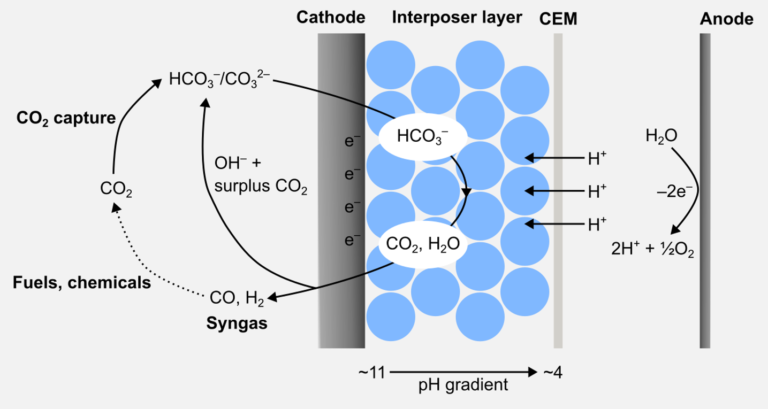
Integrated CO₂ capture and utilization systems relying on electrochemical conversion of CO₂ show great promise, as renewable-derived electricity can be used to drive the reaction. CO₂ capture and storage through bicarbonate salts is a stable, yet reversible storage form, allowing for high concentrations of bicarbonate in aqueous solutions. Identifying electrocatalysts that can directly activate and convert bicarbonate represents an ongoing challenge that we are pursuing in the group. In this regard, our main focus is on the development of single- and dual-atom catalysts, which exhibit high activities toward selected reduction products.
Furthermore, we are investigating how to manipulate the CO₂–bicarbonate equilibrium in the vicinity of the cathode in our electrochemical cells to increase the local CO₂ concentration and hence conversion. This approach allows us to convert bicarbonate solutions via in situ released CO₂ using electrocatalysts that activate CO₂ rather than bicarbonate. We aim to develop ingenious cathode designs, which enable us to tailor the diffusion layer pH and, consequently, the CO₂ concentration gradient, as well as optimize the electrolyzer to enhance conversion to useful products such as syngas or ethylene.
Highlighted Publications
Li, L.; Kong, Y.; Zhang, T.; Han, X.; Aalestrup, K.; Pedersen, S. U.; Hu, X.; Daasbjerg, K. Insights Into CO2 Loss, pH Effects, and Tafel Kinetics in Ni Single Atom-Driven Bicarbonate Electroreduction, Sci. 2026, e24353.
Contact
Daasbjerg Group
Novo Nordisk Foundation CO2 Research Center (CORC)
Aarhus University
Contact information for Prof. Kim Daasbjerg
Email: kdaa@chem.au.dk